Experience matters when you’re dealing with a pest that’s built like a dinosaur. With 30 years of experience in Canyon Lake, I’ve seen firsthand how “tough” these predators really are. My 12 years of professional chemistry training tells me that a standard “bug spray” isn’t enough for a creature this resilient. I use a technical, veteran’s approach to ensure your home isn’t a landing pad for these giants when the Texas storms roll in.
Channel Locks and Wasp Freeze: A Centipede Story
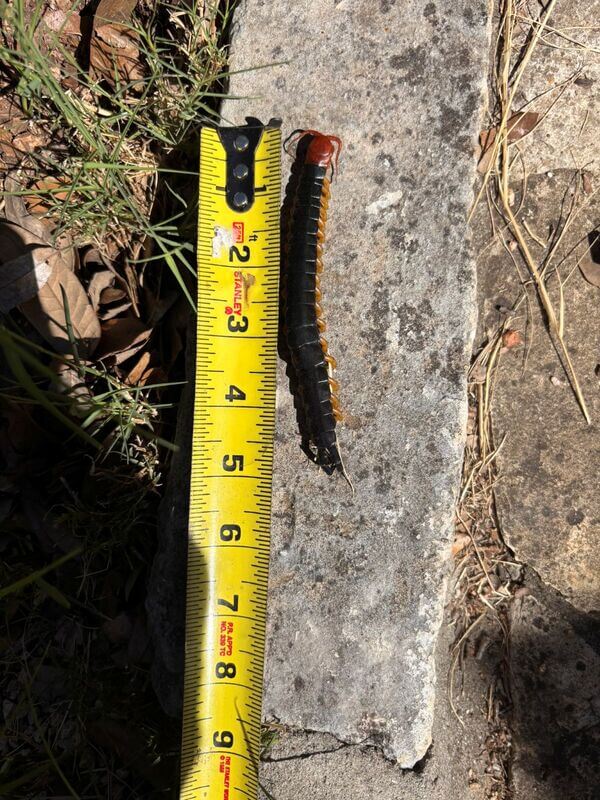
A few years ago, I was called to a brand new home for a “squirming guest” in a bathtub. It was a massive Texas Redheaded Centipede. I didn’t have a grabber tool handy, so I reached for the longest pair of Channel Lock pliers I had.
Even clamped in the pliers, this thing was aggressive—it was literally attacking the steel, trying to get to my fingers. The homeowner wanted it dead, so I took it out to the driveway and unloaded a can of Wasp Freeze on it. Now, Wasp Freeze is powerful stuff, but even after nearly an entire can, that centipede just kept moving. It took a long, long time for that “dinosaur” to finally quit.
Most people are terrified of these things for good reason. They are prehistoric, they are armored, and they are some of the hardest pests to kill in the Hill Country.
Why the “Residual” Has Its Work Cut Out
Because of their thick, armored shells and the way they move, centipedes don’t just “drop dead” when they cross a treated area. In my experience, even with the best professional chemistry, it can take 3 to 4 days for a centipede to die after coming into contact with a residual barrier. Usually, they don’t die from the poison instantly; they gradually weaken and dehydrate.
The “Storm Surge” Phenomenon
Have you noticed that you only see them inside right before a big Texas thunderstorm? There’s a reason for that. Centipedes are incredibly sensitive to barometric pressure. When a storm is brewing, they move to higher ground to avoid drowning in their outdoor burrows. When they are on a mission to escape a flood, they bypass ground perimeters and find gaps that other bugs wouldn’t even try.
Protecting your home from giants like these is a priority, especially in sensitive areas. For more on my approach to family-focused protection, read about Scorpion Safety in the Nursery.
How We Actually Handle Them
Since these “dinosaurs” are so resilient, our strategy has to be smarter than just “spraying and praying”:
Starve the Predator: Centipedes are hunters. If you have them inside, it’s because you have a food source (like crickets or roaches). We eliminate the “buffet” first.
The Debris Audit: Centipedes love leaf litter and moisture. We focus on clearing the “highways” near your foundation.
The Truth About Prevention: I’ll never tell a customer I can stop 100% of centipedes during a massive storm surge. Anyone who tells you that is lying. What I can do is make sure your home is a “dead end” for them rather than a nesting site.
While centipedes are the armored ‘tanks’ of the Hill Country, scorpions are the ‘ninjas.’ To see how scorpions use a completely different tactic to get into your home, check out my CCTV Scorpion Guide.
The Veteran Difference
You don’t want a technician who promises “magic juice.” You want a 30-year veteran who knows the biology of the Texas Hill Country. We use the right chemistry and the right strategy to keep your family safe from the pests that other companies struggle to control.
Don’t let the ‘dinosaurs’ take over your home before the next storm hits. Call today for a veteran’s audit of your property.
